

Bonusss 🔥
I keep receiving great DMs from you all, so every Friday and Saturday I’m opening up a few slots for Rankly’s Substack subscribers. Yaayyy! This is your chance to discuss your ideas/thoughts on the agentic commerce space..(here is my cal)
TL;DR
The cards are image search, not a product feed. Every product image in a Claude shopping answer comes from an image search backed by Bing. Each image carries a Bing tracking ping in its data. There is no price field, no stock field, and no buy button in the card.
No real checkout happened. The only tools that ran were Claude’s own web_search and image_search. Nothing read a live catalog, priced a product, or built a cart. The card is a search result in a nicer frame, with no price field, no stock field, and no buy button.
The prices are written by the model, not fetched. Every price sits in the answer text as prose, not in a structured field from a live store. In one answer Claude even added “prices fluctuate, so check current listings before buying.” It will not stand behind its own numbers.
Attribution is broken. The links out of the card carry no tracking tag. The only telemetry attached is Bing’s. A merchant cannot tell that a visit or a sale came from Claude.
What wins today is search, not a catalog. The products that showed up did so through web search and image search. In one case a brand’s own “best under $100” blog got its own product named the top pick. Being the source the answer engine reads is the whole game right now.
Claude has started showing product images in its shopping answers, and they look a lot like the shopping cards you see in Google or a store. That raised an obvious question for anyone who cares about being found by AI: where does that data come from, how fresh is it, and can a brand influence it? So we did the simple thing. We ran real shopping queries, saved the raw response each time, and read what was actually inside. This is what we found, in plain terms.
What we did
We captured three shopping conversations from claude.ai in a normal, logged-in browser session, and saved the full response payload for each. No special tooling, just the data the browser already receives. Three queries, two regions, two product categories:

Three sessions, three categories, two regions, and the same result every time: no live catalog, no cart, no checkout. Just search, laid out to look like a store. The next sections walk through what it did instead, one piece at a time.
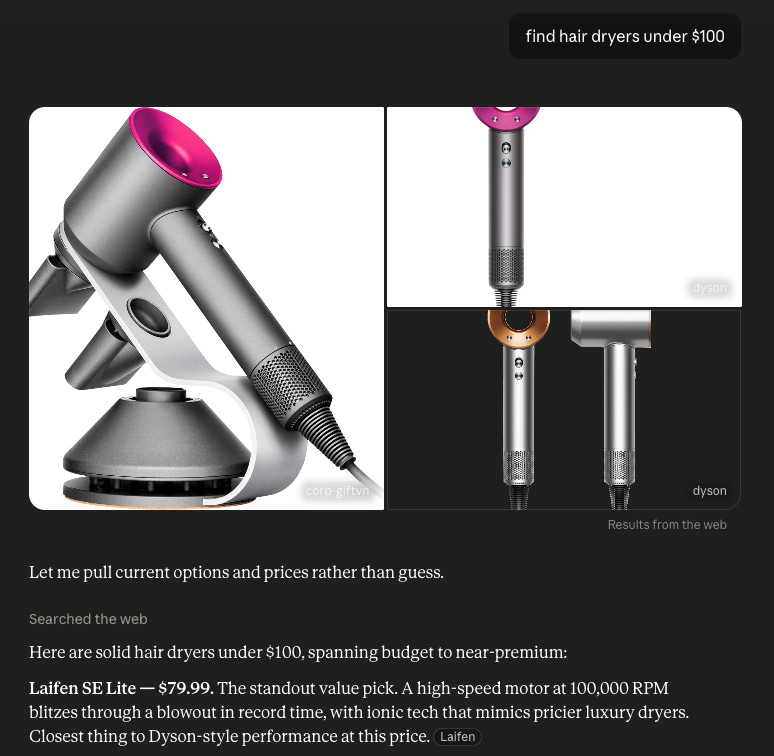
When Claude shows a row of product photos, that row is the result of a tool called image_search. The answer even labels it under each gallery: “Results from the web.” For each product, Claude runs a separate image search (”Hoka Clifton 9 running shoe”, “Dyson Supersonic hair dryer”) and gets back three images. Here is what one image object actually contains:
{
  "id": "img_1",
  "url": ".../clifton-9.png",
  "title": "Men's Clifton 9 Running Shoe | HOKA",
  "source": "hoka.com",
  "page_url": "https://www.hoka.com/en/us/.../clifton-9/...",
  "width": 1650, "height": 1339,
  "telemetry": "{... bingapis.com/api/ping ...}"
}
Read that list of fields carefully, because what is missing matters more than what is there. There is a picture, a title, a domain, a link, and pixel dimensions. There is a telemetry blob that pings bingapis.com, which tells us the images come from Bing’s image index. That matches Anthropic’s own documentation, which says Claude selects images from web-search results powered by Bing, each with a source link. What is not there: no price, no currency, no in-stock flag, no size or variant, no seller record, no add-to-cart. This is the shape of a search result, not a product listing. The card looks like commerce, but the data underneath it is a web image search.
What actually built the answer
So if the card is a search result, what did the work? In every session, only two tools ran, and both are Claude’s own built-ins:
image_search   -> the product photos in the gallery
web_search     -> the picks, the rankings, the prices
That is the whole engine. Claude picks products and prices from a web search, then runs an image search per product to decorate each one with photos. Nothing in the flow reads a live catalog, checks real stock, or prices a specific listing. There is no catalog lookup, no cart, no checkout, because none of that is what is happening. The shopping answer is Claude’s general search ability, pointed at a shopping question and laid out to look like a store.
This is the single most important thing to understand about these cards. They are not a product feed pretending to be search. They are search, dressed as a product feed. Everything else in this teardown, the prices, the links, the attribution, follows from that one fact.
The prices are written, not fetched
Look at where the prices live. In the payload, a line like “Laifen SE Lite, $79.99” or “Nike Vaporfly 3 (~$260)” is plain answer text, written by the model. It is not a value returned by any tool. No tool in any of our sessions returned a price at all. So the numbers are the model’s own estimate, decorated with a photo from image search, not a live quote from a store.
The clearest tell came in the hair dryer answer. Claude first ran an image search, then stopped and said, in the response itself, “Let me pull current options and prices rather than guess,” and ran a web_search for a “best under $100” roundup. Then it closed with: “Prices fluctuate, so check current listings before buying.” That is the system telling you, in its own words, that the price on the card may be stale and it will not stand behind it. For anything where price and availability are the whole decision, that is a real limit, and it is the direct consequence of there being no live feed underneath.
Attribution is broken
Now think about the link. When a user clicks a product image, they go to the page_url, for example a bare Nike or Hoka product page. Two problems fall out of that, and both hit brands directly.
First, the outbound link has no tracking tag on it. No utm_source=claude, nothing. So when that click lands in the merchant’s analytics, it looks like plain direct or referral traffic, indistinguishable from someone who typed the URL. The merchant cannot tell the visit came from Claude. This is a known gap, there is an open request on Anthropic’s own tracker asking Claude to add UTM parameters to the links it emits, which only exists because it does not add them today. Second, the only tracking that does exist points the other way: every image carries that bingapis.com ping, which logs the impression for the image index, not for the store. So the signal that a shopper saw your product inside Claude is captured upstream and never handed to the brand. You can be shown in a Claude shopping answer and have no way to measure it. Closing exactly that gap, seeing which AI surfaces show your brand and drive traffic, is what agent analytics exists for.
The links point everywhere
Because the images come from a global image index rather than one merchant, the links scatter across countries. Our US hair dryer query returned a top Dyson image linking to a Vietnamese corporate-gift site and to Dyson India’s business page, plus product links to Malaysia and the Philippines (Shopee), Ireland, and Ecuador. The US running shoe query pulled Nike India, Nike Malaysia, and Nike Canada pages for the same shoe.
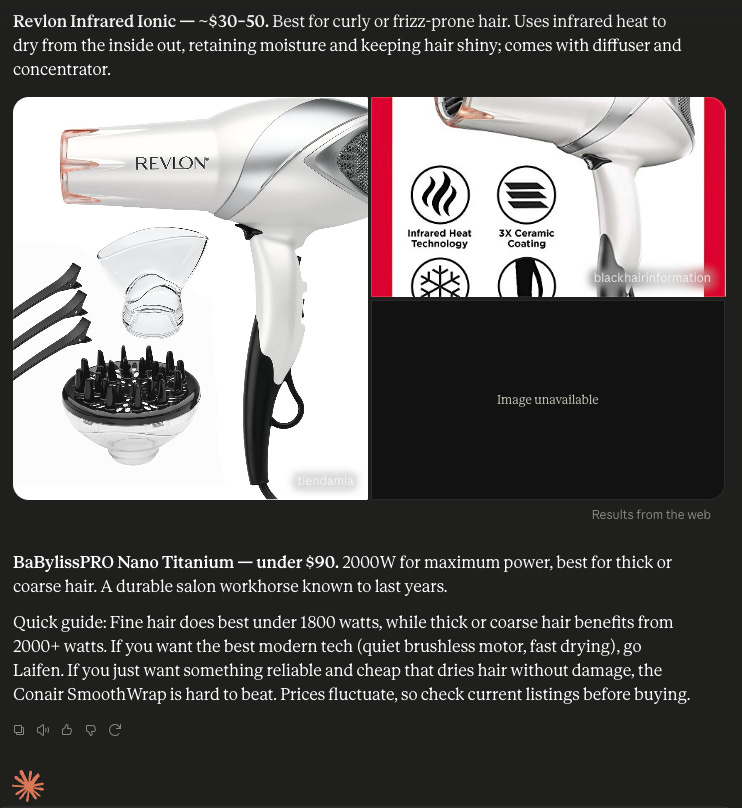
For the user this is a poor experience: you click a shoe and land on a storefront in the wrong country, in the wrong currency, that you may not be able to buy from. For a brand it means you cannot count on your local, buyable listing being the one shown. A real product feed would return one consistent merchant with a price and a stock status. An image index returns whichever photo ranked highest, from any country, with none of that. This is the difference between search dressed as commerce and actual commerce, made visible in the links.
So how do you show up
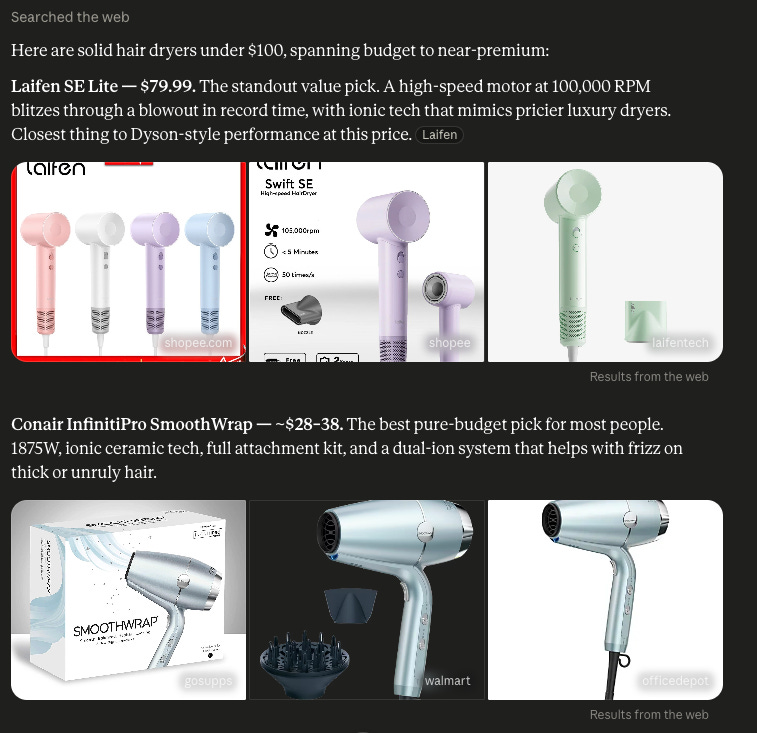
Here is the useful part. Since the shopping answer is built from web search and image search, the levers that decide whether your product appears are the same ones that decide whether you show up in any AI answer. Two things stood out in our captures. Your product images need to be indexed and clearly named, because the card is literally an image search for “[product name]”, so the file, its title, and the page it sits on all need to say plainly what the product is. And the editorial roundups matter enormously: in the hair dryer test, the top pick was “Laifen SE Lite”, cited to laifentech.com, which is Laifen’s own blog post ranking Laifen’s own product number one. A brand that owned the “best under $100” roundup on its own domain got itself recommended, with a citation, inside Claude.
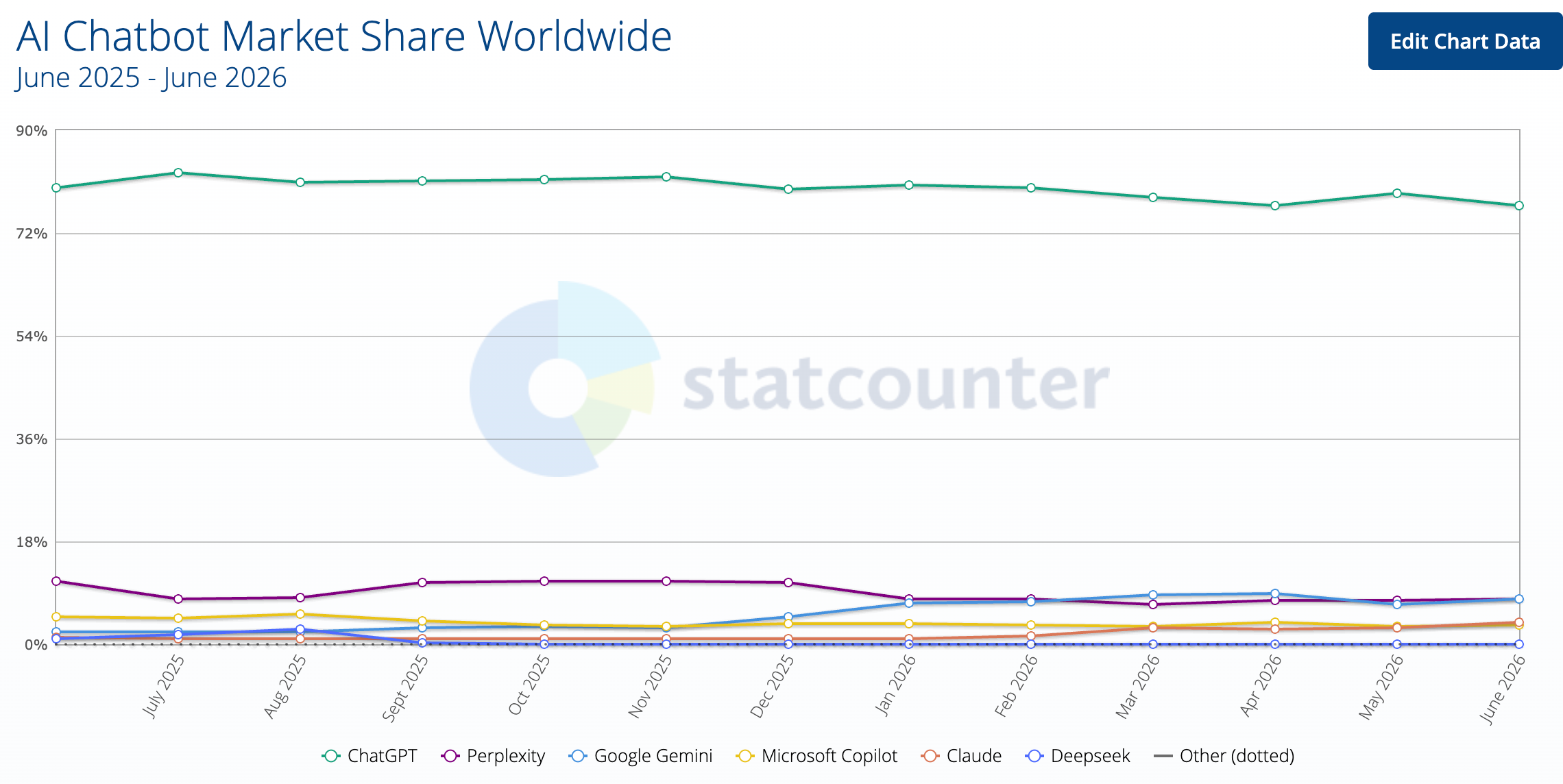
A word of caution before you over-read any of this. This is very early. Claude has clearly cracked the coding space, but its consumer chatbot is still a small slice of the market, about 3.7 percent of AI chatbot use worldwide (Statcounter, June 2026), against ChatGPT’s three quarters. So this shopping surface may be a real bet or may be an experiment they are trying out, and it is too soon to tell which. It is worth watching over the next few months to see whether Claude builds this into a genuine shopping experience or lets it sit.
Note: This stat doesn’t include Google AI Mode and Google AI Overviews (zero clicks!!)

Either way, the move for a brand today is the same. Since the answer is built from web and image search, the thing that gets your product named, pictured, and linked is being the source the model reads: indexed images, clean product pages, and strong editorial coverage in the words a shopper would use. We will keep pulling these apart as the surface develops.
Nice, really interesting breakdown!
Important information